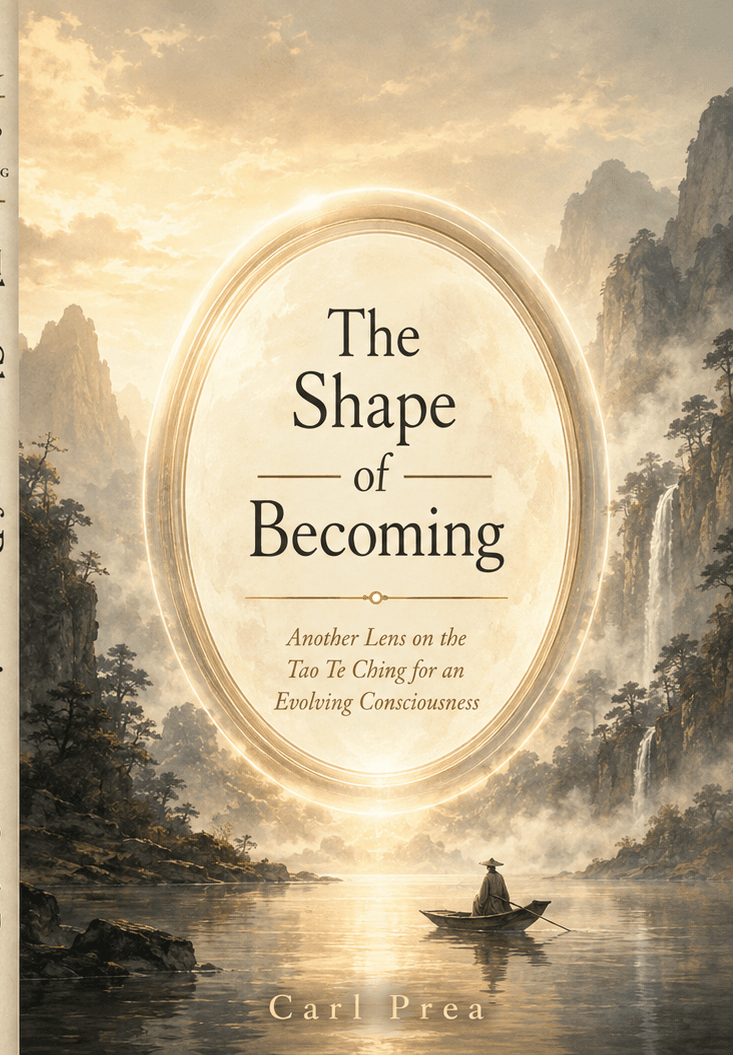
The Shape of Becoming — Tao Te Ching
Another Lens on the Tao Te Ching for an Evolving Consciousness
Published by Awaken Away Publishing
Tradition: Tao Te Ching
What if becoming does not always require more effort—and some of our deepest growth begins when unnecessary forcing falls away?
About
About this book
The Shape of Becoming — Tao Te Ching brings contemporary questions about consciousness, identity, agency, ambition, power, leadership, and transformation into conversation with one of the world’s most enduring texts.
It does not present itself as a new translation of the Tao Te Ching, a comprehensive account of Daoist philosophy, or a claim to the one correct interpretation. Instead, it approaches Laozi carefully enough to let the ancient teaching resist modern assumptions—including the assumption that growth must always mean more effort, more achievement, more control, more knowledge, or more becoming.
The book begins with a distinctly human strength: we have become extraordinarily good at pushing. We push matter, productivity, relationships, bodies, careers, healing, spiritual practice, and ourselves. Much of civilization exists because human beings learned to intervene. But every strength carries a question: what happens when the creature who has learned how to push no longer knows when not to?
Through images of water, valleys, empty vessels, muddy water, roots, uncarved wood, rivers, rulers, and the mysterious Way itself, the Tao offers another vocabulary of power. Softness can endure where hardness breaks. Emptiness can make something useful. Leadership can become lighter by remaining below. Action can become more skillful when unnecessary forcing disappears. Accomplishment need not become possession.
The volume does not ask the reader to abandon agency.
It asks whether agency becomes wiser when it learns restraint.
For the reader
This book may be for you if…
- You are interested in the Tao Te Ching but want an accessible contemplative encounter rather than a technical commentary.
- You have spent years trying to improve, achieve, heal, control, or optimize—and are beginning to wonder about the cost of constant pushing.
- You are interested in consciousness but want ancient traditions allowed to challenge modern spiritual assumptions.
- You are drawn to questions of effort, enoughness, simplicity, leadership, humility, and non-forcing.
- You appreciate teachings that use paradox rather than resolving everything into a neat answer.
- You want a book that values human agency without making control the measure of human strength.
Themes
What you’ll explore
- The limits of naming and conceptual certainty
- Paradox, mystery, and knowing that you do not know
- Emptiness as usefulness rather than lack
- Wuwei and the art of non-forcing
- Water as a model of strength without contention
- Identity, simplicity, and the uncarved block
- Enoughness and knowing when to stop
- Leadership without domination or unnecessary weight
- Creating without controlling
- Participating in becoming without possessing what emerges
Continue exploring
Related books
The Shape of Becoming — Emerald Tablet
Another Lens on the Emerald Tablet for an Evolving Consciousness
Explore book